Showing posts with label star trek. Show all posts

Tuesday, August 28, 2018

Faith of the Heart: On Star Trek Enterprise's Opening Title


          When I watched my first episode of Star Trek Enterprise, I was almost appalled by the opening titles. What is this strange song? Why are there almost country sounding lyrics instead of the beautiful, transcendent instrumentals of previous series? And what are all of these weird historical clips instead of images of planets and the Enterprise? Simply put, after just rewatching Next Generation and Deep Space 9, I had very high standards and did not like change. 

 
            However, just half a season into Enterprise, I was warming up to the concept and the characters, and instead of immediately skipping the opening titles, I was beginning to listen. The song was getting stuck in my head, and I found myself weirdly inspired by it. As I examined it more, I realized that both the opening titles and the show itself resonates the closest to where we as a species are today. We are barely starting to explore realistic ideas of interplanetary travel, and traveling between systems is nearly inconceivable.

Yet as the world seems to be devolving into chaos more every year, it is more important than ever to have a future that is worth moving towards, one that is neither a dystopic nightmare nor a futuristic copy of the problems we already have. One of Star Trek’s main themes is that the human spirit is about exploration and discovery, not about violence and hatred and suffering. It is based on the faith that we are and will continue improving and growing as a species.  

Enterprise’s opening titles does not focus on exploring new worlds and finding new civilizations, though that is still the Enterprise’s primary mission. Instead, it focuses on the path of progress that got humanity to the point they are at in 2151 at the start of Enterprise season 1. The opening titles start as Rob Stewart’s Song “Faith of the Heart” plays over a view of earth. This is important because unlike other shows that begin by showing other planets or space stations far away, Enterprise begins at Earth. We are still grounded here on earth, unable to go farther, but in Enterprise, humans are finally able to use warp travel to begin moving beyond the Sun's solar system.

 

 The first verse is “It’s been a long road getting from there to here. It’s been a long time, but my time is finally near.” This is fitting to the clips and the theme of this part of the opening, for most of the opening titles are depictions of humanity’s past navigating and exploring. The opening shows a small ship navigating in the ocean and progresses to a large sailing ship, specifically the HMS Enterprise. A few clips later, the space shuttle Enterprise appears as well. These two Enterprise ships not only begin to show the progression of navigation technology, it also acts as a reminder that Enterprise’s legacy started long before space travel, and so did humanity’s desire to explore. As the opening shows clips of sea travel and navigation, the lyrics of the song are, “And I will see my dream come alive at last, I will touch the sky.” This implies that the dream is always to explore farther and higher than they could get before, and these lyrics act as a beautiful transition from sea travel and exploration to air and space travel as the lyrics “touch the sky” fade out as clips from air and space travel fade in. It demonstrates that humanity is always moving forward, trying to reach new heights that were previously impossible. 
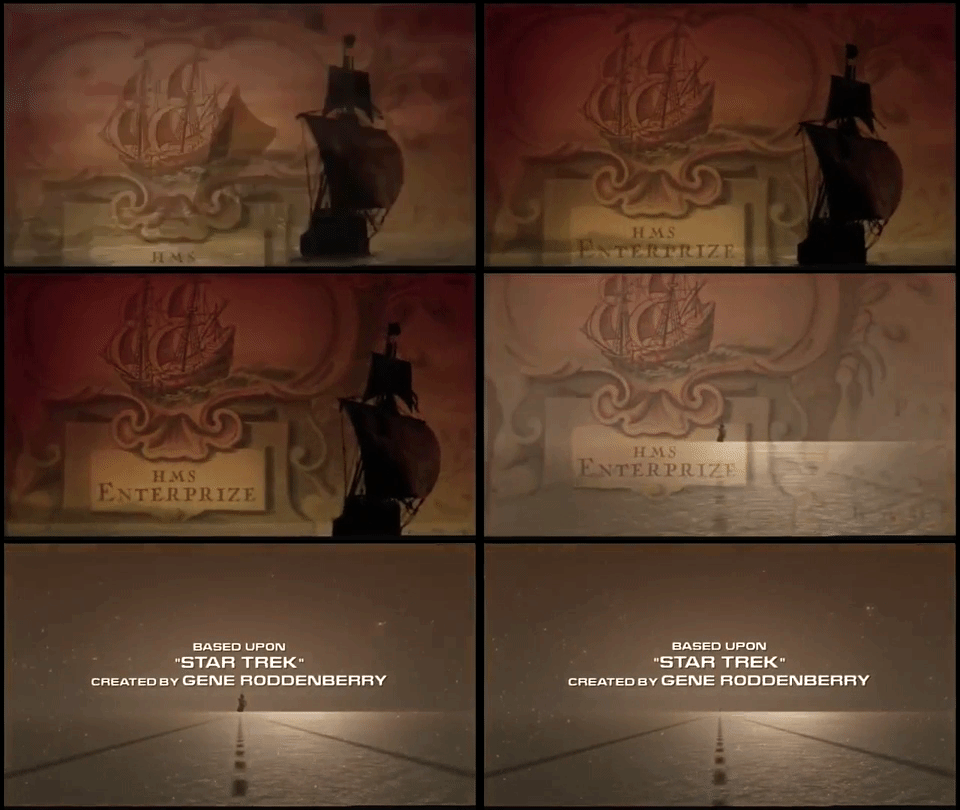

Sea travel shifts to air and space exploration. There are clips of a hot air balloon, the Spirit of St. Louis, the Wright brothers’ plane, a jet, an underwater science vessel, astronauts flying in their ship and walking on the moon, space telescopes and satellites, and a rover on mars. Time progresses quickly through just a few centuries, clearly illustrating the technological progress that humans have made to help them explore and discover new areas within and around our own world. The amount of progress shown in less than a minute is staggering considering these inventions span over just a few centuries, and it acts as a testament to human’s technological progress, but this opening is about more than showing off scientific progress. Part of the lyrics as these clips play includes, “I can do anything. I’ve got strength of the soul. No one’s going to bend nor break me.” This alludes to more than just the technology shown in the clips, indicating that this exploration is about humanity’s strength and soulfulness as well as discovery and progress. The last line, “no one’s going to bend nor break me” can also be interpreted with the hopeful lens that Star Trek has, indicating that humanity will keep moving forward and won’t be broken, even during difficult times. 


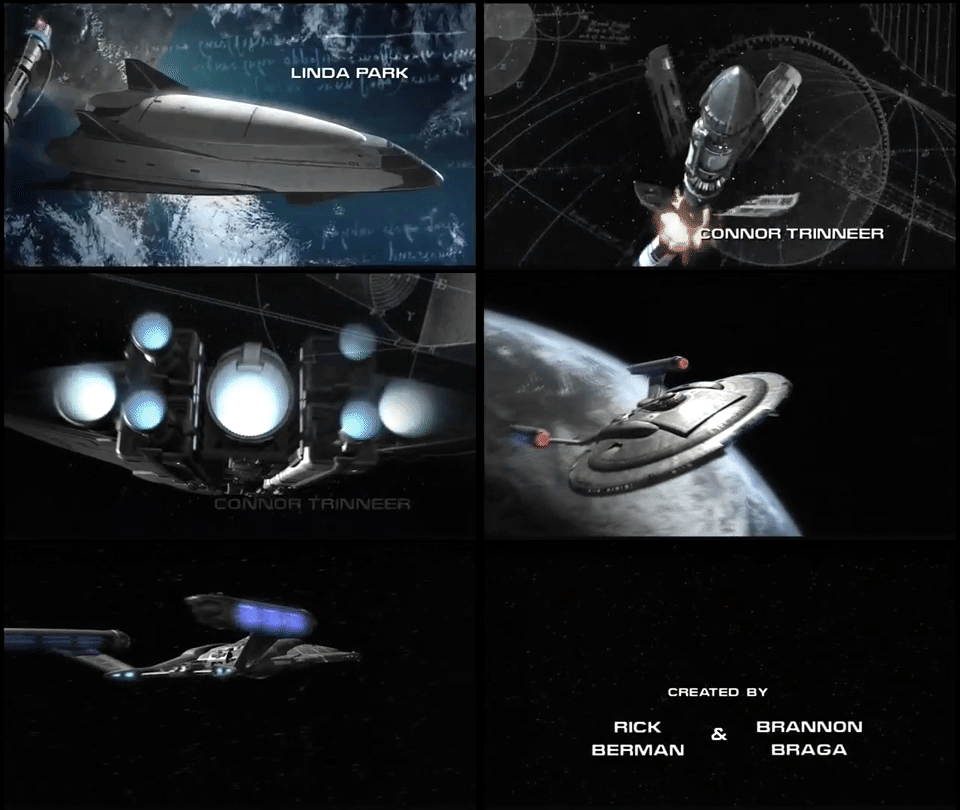
The most moving two lines of the song for me personally are “I can reach any star. I’ve got faith, faith of the heart.” These two lines are sung during the transition from current, real inventions to a few inventions in the future, ending on the Enterprise warping away. The opening title ends on the almost obligatory blink of the ship disappearing into space, a call back to the opening titles of both the Original Series and Next Generation. This short part of the opening titles builds on the minute or so of the clips of humanity’s past technology for exploration and discovery. Enterprise’s opening title is a reminder of how far we have come and the progress that we have made, and it is a reminder that if we keep having faith, then we can “reach any star” as long as we have “faith of the heart,” a faith that goes beyond the technology itself. This opening title builds on Star Trek’s optimism and encourages progress fueled by exploration and heartfelt desires, not war or greed or fear, instead focusing on reaching for the stars and going where no one has gone before. 
 

Friday, April 6, 2018

Monster of the Man Trap: The Beginning of Star Trek's Morality


     “The Man Trap” is the first episode after the pilot of the original Star Trek series, and right from the start, it demonstrates that Star Trek will be a series beyond simple shoot ‘em up cowboys in space as they explore the final frontier. The original series of star trek first aired in 1966 in a time of hope and rebellion coupled with fear and oppression. Star Trek was a hopeful vision of the future in the 2360s. This version of the future was one where men and women of all races and nationalities (and even alien species) worked together. However, even in this largely perfect version of humanity’s future where pollution is gone and all nations are working in harmony on earth, there are still enemies and monsters, often in the form of unknown aliens. In this episode, their adversary is the creature of M-113, often called a salt monster or salt vampire, and their struggle to survive is reminiscent of other vampire or monster stories such as Bram Stoker’s Dracula. The salt vampire is the first alien creature to air on Star Trek, aside from the pilot episode, and it is also the first alien killed. The nuanced portrayal of the salt creature and the complicated nature of its death sets the complex and thoughtful tone for Star Trek: the Original Series and all the reboots to follow.
             The salt vampire is an alien version of the blood sucking vampire in hundreds of earth stories such as Dracula, but this version does not portray the creature as a purely monstrous, evil entity. The creature has many similarities to the various versions of vampires. It needs to drain something that is essential to humans in order for it to survive, in this case salt instead sucking salt instead of blood. The creature is stronger and hardier than the other people on the ship, and it is willing to kill in order to satisfy its hunger and continue to survive. It poses a real danger to the crew of the Enterprise, but it does not have the monstrous, evil motives as other classic monsters do. For example, Dracula was soulless, an evil creature bent on crippling humanity and creating a following off vampires. Another monstrous creature is Frankenstein’s creation who, though more complicated as a character, still causes destruction and death out of anger, frustration, and the desire to see his creator suffer. There is no malevolence or evil attached to the salt vampire’s actions. Despite its alien and somewhat monstrous appearance, its actions are purely a matter of survival. Even when the creature assumes the form of Nancy, Dr. McCoy’s friend from his past, she does so as a survival technique, just as an octopus takes on different skins to fool predators or trick prey. She does not do so to toy with McCoy’s heart out of cruelty, but instead tries to use her identity as Nancy to help her survive. From the very beginning, Star Trek proposes that monstrosity, in creatures and people alike, is more complicated than the storybook pictures so often created with monsters and heroes.


      Just as the creature is not portrayed as a malicious monster, its death is not portrayed as a heroic or glorious act. McCoy shoots the creature not out of vengeance or honor, but instead to keep it from killing Kirk. Just before it is killed, the creature transforms back into the image of Nancy, making it seems as if it is a human in distress, not a dangerous alien creature. As McCoy fires the killing shot, he whispers, “Lord forgive me,” acknowledging that however monstrous and dangerous the creature was to the human crew, the act of its destruction is regrettable, even monstrous in itself. This creature is the last of its kind, so when it is killed, there is the overtone of that race’s extinction. Kirk makes this point unmistakable at the end of the episode when he says, “I was thinking about the Buffalo.” Kirk reflects that they have just destroyed an entire race, just as the Buffalo were almost wiped out by humans in the 19th century, and the salt vampires were a race that had as much right to live as they do. Unlike the destruction of vampires like Dracula in old stories, the death of the creature was not carried out to save humanity as a whole but instead a regrettable act of personal self-defense. The creature was monstrous looking, and it murdered many people in order to survive. Though it is monstrous to the crew of the Enterprise that it puts in danger, the salt vampire is still depicted as a creature that should have just as much right to survive as any other lifeform. 
The salt vampire was just one of the many complicated adversaries to come up against the crew of the enterprise. During the original series and the number of series to follow, there were dozens more opponents, adversaries, and enemies. Some were individual enemies, while others were entire races such as the Klingons, Ferengi, and Cardassians. As the shows progressed, each enemy and race progressively became more complicated, and as their stories grew more complex, it became impossible to label entire races as the enemy. For lack of a better term, they were humanized and became more real. Races of people began transform from an entire race of likeminded enemies into individuals with complicated thoughts and feelings and motives.  Klingons eventually became the federation’s ally, and when Commander Worf joined the picture as a crew member on the USS Enterprise D, Klingon culture and ideologies were explored and validated. In Deep Space 9, both Ferengi and Cardassians are fleshed out and expanded through the characters of Quark, Nog, Garrick, and the other Ferengi and Cardassians that various episodes explored. Every race and person becomes more than just a simple enemy that can be destroyed without question. Star Trek stresses the importance of all life, not just human life (though humans do seem to possess a note of distinction, likely because it was written by humans who are egocentric). Though this humanization and exploration of morals is a much bigger picture throughout the entirety of Star Trek series, the complicated portrayal of the enemy for Star Trek all began with the monster of the man trap, a simple creature from M-113 in the very first episode.